ES. What inspired you to found Emogg, and how did your early background in biology and industrial design shape the company’s mission?
Edgar Sanjuán. The origin of the story is quite unique. Let me explain. For more than 10 years, I worked in the events sector—congresses, conferences, and corporate meetings—applying a methodology that is not very well known: visual thinking. During that time, I focused on translating the most relevant concepts from strategic meetings and keynote presentations into visual language, live.
I worked with large multinational companies such as Danone, Roche, and Novartis, but I constantly asked myself the same question: what really matters most to the audience?
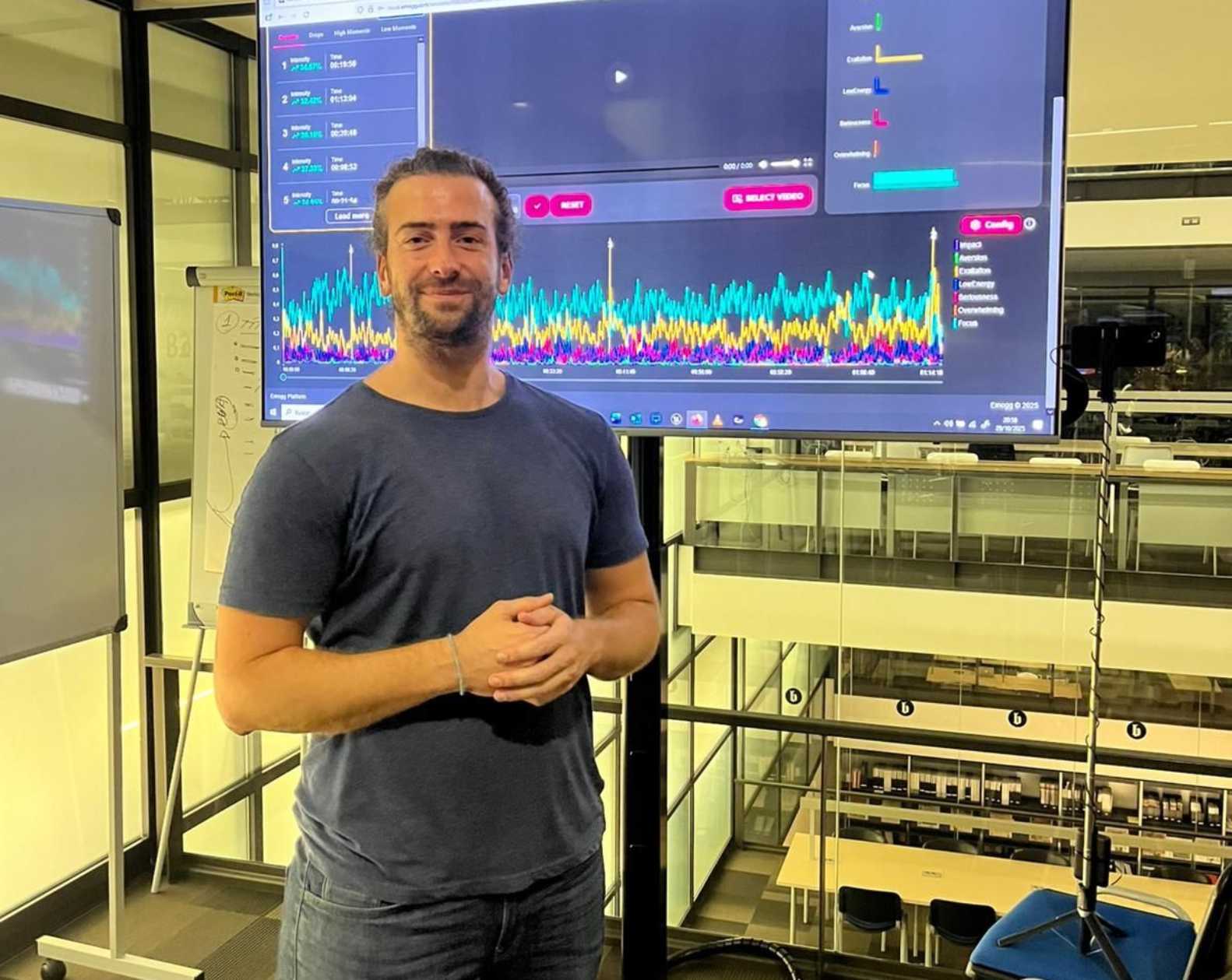
In 2014, I met Richi, a mental coach for elite athletes and an expert in understanding people’s emotional and cognitive states. He used this knowledge to maximize performance in professional athletes. In 2017 we started working together and realized that his expertise could be transformed into algorithms, allowing us to understand what audiences feel during events and meetings.
In 2020, together with another partner, we founded Emogg Analytics®.
I believe the influence of my previous studies is clearly reflected in the project: the scientific foundation of Emogg Analytics® comes from biology, while the design thinking approach—from industrial design—is focused on solving real customer problems through our solution.
ES. How do you ensure privacy and ethical use of emotional data-especially in live event settings?
Edgar Sanjuán. Privacy is extremely important to us. The company is based in Barcelona, Spain, which places us under
one of the strictest data protection and privacy jurisdictions in the world: European GDPR (General Data Protection Regulation).
In addition, as the project’s founder, I am personally very sensitive to these issues. From the very beginning, we designed the solution to measure events and content, not people.
To measure what an audience feels during a meeting, congress, or live event, Emogg Analytics® complies with the following principles:
It does not store images or videos of the audience; all data is analyzed in real time.
Data is always aggregated at audience level, never individual.
It does not use facial recognition to infer the indicators we measure.
It does not collect biometric, sensitive, or personal data that could allow the identification of any individual after the analysis.
Emogg Analytics® is not a security or access-control company. We are a solution designed to help event marketers and event organizers understand the impact of their events and content, optimize results, increase engagement, and deliver more effective communication.
ES. What are your strategic priorities for scaling Emogg over the next 12–24 months?
Edgar Sanjuán. Our main priority is to consolidate Emogg as the reference solution for objective event and experience measurement at both national (Spain) and European levels. To achieve this, we are closing agreements with major event agencies, audiovisual technical companies, and exhibition venues to deploy our solution across the territory.
At the same time, with a medium- to long-term perspective, we are beginning to work with international companies in the United States and Latin America to expand beyond Europe. In this context, we are actively seeking international partners who want to bring strategic value to their clients within the MICE ecosystem.
If you are an agency, a brand, or an audiovisual technical company and would like to learn more about the solution and our partnership models, we invite you to get in touch with us via our website at emogg.com.
ES. What advice would you give to founders looking to build tech solutions at the intersection of human behavior and data science?
Edgar Sanjuán. I would say that the most important aspect is empirical validation of the solution’s benefits. This requires significant time and investment to develop the necessary studies that demonstrate the value, quality, and reliability of the results.
At Emogg Analytics®, we were very aware of this from the very beginning. That is why we launched a parallel implementation vertical in the healthcare sector. We have collaboration agreements with healthcare institutions, such as hospitals, where we provide our solution so they can conduct scientific studies. Thanks to the results of these studies, we are able to scientifically validate both the value of the solution and the reliability of the data we deliver.