
ES. Your latest jwc report (the Global Industry Performance Review – GIPR) suggests the global exhibition industry is stabilising with moderate growth expected across most regions. How would you describe the current phase of the industry — recovery, expansion, or structural transformation?
Sebastian Witt. It is no longer a recovery phase. That ended in 2024, when most major markets surpassed 2019 revenue levels. What we are seeing now at jwc is stabilisation under normalised growth conditions, with global revenues forecast to grow at around 3.3% annually through 2030, broadly in line with global GDP.
The more relevant shift is structural. Revenue has recovered faster than net rented space, reflecting higher pricing, changes in exhibitor mix and a rising contribution from services . Physical expansion remains constrained in many established markets, particularly in Europe and North America.
At the same time, regional trajectories are diverging and market share continues to concentrate among the largest organisers. In that sense, this is not a new expansion cycle. It is a period of structural adjustment, where relative performance between regions, sectors and business models becomes more visible — and more decisive.
ES. Economic conditions and geopolitical uncertainty remain among the top business concerns globally. How are organisers practically adapting their strategies to manage these macro risks while continuing to expand internationally?
Sebastian Witt. While some regions are currently facing higher levels of uncertainty and volatility, we see organisers reacting in a fairly pragmatic way. Rather than stepping back from international expansion altogether, they are shifting their focus towards markets that offer more stability and clearer economic prospects.
This reflects a broader trend in the global economy. When established partnerships become more difficult due to geopolitical tensions or regulatory changes, businesses look for new opportunities in other regions. Exhibition organisers are doing the same. They are diversifying their portfolios, spreading risk across different markets, and being more selective about where they invest and grow.

ES. Emerging markets like the Middle East, India, and parts of Latin America are showing strong revenue growth. What structural factors are driving this momentum, and do you see this shifting the global centre of exhibition power?
Sebastian Witt. Different markets offer different value
propositions, and that largely explains the current momentum.
In the more established Middle Eastern markets, such as the UAE or Qatar, the strength lies in their role as international meeting points, effectively “East meets West” platforms. They benefit from strong infrastructure, good connectivity and a business-friendly environment, which makes them attractive hubs for international editions of established brands. Saudi Arabia is somewhat different. There, the focus for many organisers is less about acting as a global hub and more about entering and developing a large and fast-growing domestic market, supported by significant government investment and economic diversification efforts.
India and parts of Latin America show strong growth for another reason: the exhibition industry in these regions is still comparatively underdeveloped relative to the size of their economies and populations. That creates structural upside potential. As local industries formalise and internationalise, demand for professional trade platforms naturally increases.
Looking ahead, we will certainly see new markets gaining relevance and a more diversified global landscape. However, over the next decade, we do not expect a fundamental shift in the global centre of exhibition power. The established major markets will remain dominant, even as emerging regions close part of the gap.
ES. Are we entering a phase where growth will depend more on operational efficiency than market expansion?
Sebastian Witt. It very much depends on the region.
In mature and highly developed markets, particularly in Europe, future growth will be less about simply increasing net square metres and more about delivering stronger value to stakeholders. Organisers are focusing more on profitability, pricing strategies, content quality, and measurable ROI for exhibitors and visitors. Growth in space alone is no longer the primary success metric.
In many emerging markets, however, market expansion remains a key growth driver. As industries and economies grow, there is still room for new launches, geographic expansion, and increases in overall exhibition capacity.
ES. There is only limited deep integration or proprietary development of AI across the industry. What is holding the industry back from full-scale AI adoption, and where do you see the first real commercial breakthroughs?
Sebastian Witt. The barrier is not technology, it is economics. AI is widely used for content creation, marketing automation and internal productivity. But the industry discussion has focused on efficiency rather than revenue impact . As long as AI is framed as a cost tool, integration will remain shallow.
There are also structural limits. Many organisers operate with fragmented data, legacy IT and tight capital allocation. Proprietary AI development requires reliable data environments and clear commercial use cases. That foundation is uneven.
At jwc, we map AI applications in a matrix with two axes: customer value and organiser revenue potential. Most current use cases sit in the low-revenue quadrant. The first commercial breakthroughs will come where AI directly affects monetisable outcomes: pricing optimisation, paid lead qualification, premium matchmaking, and data-backed sponsorship products. That is the shift from operational support to revenue design.
ES. Is the industry moving toward multi-service platform models rather than traditional exhibition organising?
Sebastian Witt. Partly so, and mainly in mature markets. In established exhibition economies, floor space still represents more than 50% of total revenue, but its share is declining. Service revenues (think on-site services, sponsorship, ticketing and subscription models) are growing faster. Revenue growth is increasingly driven by pricing models and services built around the event rather than by physical expansion. Organisers are investing in data capabilities, hybrid products and year-round community offers. Some are acquiring media and digital assets to develop subscription
and membership income. These elements extend monetisation beyond show dates.
However, the exhibition remains the core product. The shift is incremental. Most businesses are adding service layers and recurring revenue streams around a space-driven model, not replacing it.
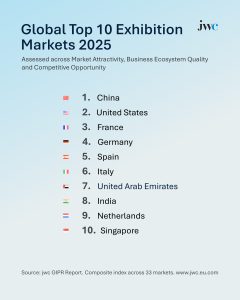
ES. India is among the strongest growth markets in revenues, hiring and operating profit expectations, and also ranks highly in market attractiveness in the new GIPR framework. What structural advantages are positioning India as a long-term global exhibition growth engine?
Sebastian Witt. India’s structural advantages are primarily macroeconomic. The country combines scale – in terms of population and GDP – with one of the strongest long-term economic growth outlooks among major economies. That alone creates a powerful foundation for sustained exhibition demand. At the same time, the exhibition industry in India is still relatively underdeveloped compared to the size of its economy and industrial base. Exhibition capacity per capita and per unit of GDP remains low by international standards. This gap represents significant structural upside.
ES. With strong expansion forecasts, infrastructure investment, and rising demand, what are the biggest risks that could slow India’s exhibition growth — capacity, policy, talent, or market maturity?
Sebastian Witt. The biggest structural risk for India is that the exhibition industry is not yet treated as a strategic priority at policy level. In most leading exhibition markets globally, the sector benefits – directly or indirectly – from supportive government frameworks. This includes coordinated infrastructure planning, destination marketing support and recognition of exhibitions as trade and economic development platforms. In India, this policy alignment is still evolving and not yet consistent across states.
Infrastructure is another key constraint. Despite recent investments, India’s total indoor exhibition space remains very limited relative to the size of the country and its economy. With roughly around 660,000 m² of indoor exhibition space nationwide, India offers a comparable scale to what cities like Frankfurt and Cologne provide combined. For a country of India’s size, that is clearly insufficient to support long-term structural growth.
ES. What is your message for the Decennial edition of Exhibition Excellence Awards 2026?
Sebastian Witt. My sincere congratulations to the Exhibition Excellence Awards on reaching this impressive ten-year milestone. We are thrilled and honored to be a part in this years special edition!