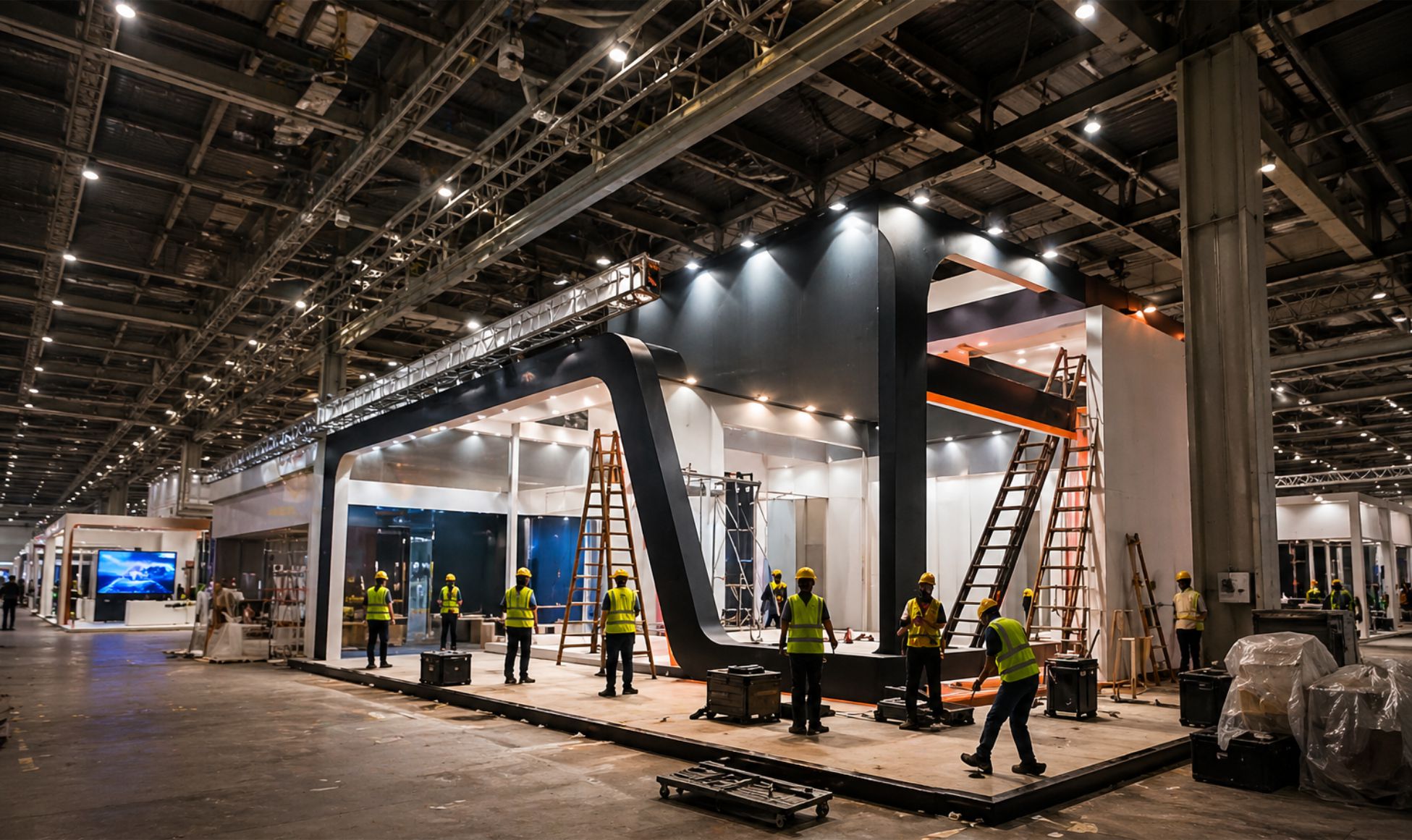
At every exhibition, the spotlight is on brands—their products, messaging, and presence. Yet behind every successful booth stands a far less visible force: the stall fabricator. These professionals are not merely builders, but engineers, planners, and problem-solvers operating under intense pressure, precision, and time constraints.
 Sanyal Desai, Organiser and Founder & CEO, Radeecal Communication & Design Culture Hub, offers a rare dual perspective—as both a producer and consumer of fabrication services. He explains, “The future of stall fabrication is no longer about just structures; it’s about creating experience-driven environments where creativity and technology become key differentiators.”
Industry estimates underline this shift. The global exhibition stand and fabrication market is steadily expanding, driven by the growing demand for immersive brand experiences. The exhibition stand builder services segment alone is projected to grow from approximately $17.8 billion in 2025 to over $28.4 billion by 2032. At a broader level, the overall exhibition stand market could reach nearly $73.9 billion by 2032, reinforcing fabrication’s role as a critical pillar in the global exhibition ecosystem.
 Shivali Mehta, CEO, Aimsite Events, captures this evolution succinctly: “The industry is moving from being execution-driven to experience-led. Today, it’s not about how well a structure is built, but how effectively it communicates a brand’s story.”
Despite this growth, one constant remains—execution defines success. A typical stall fabrication company operates as a complete production ecosystem, integrating design studios, manufacturing units, and on-site teams. Larger players often run facilities exceeding 20,000 sq. ft., handling everything from 3D visualization to final installation within highly compressed timelines.
Unlike traditional construction, fabrication operates on rapid 2–5 day build cycles, usually within controlled exhibition venues with strict deadlines. Once the event begins, there is zero margin for error. From an organiser’s perspective, the pressure is even more pronounced. As Sanyal Desai notes, “We depend on fabricators not just for execution, but for reliability under extreme timelines, because any delay directly impacts exhibitor experience.”
Amar Devani, Founder, Link Promotion and Exhibits, reinforces this reality: “It’s not just about design or construction—it’s about bringing ideas to life under real-world constraints like time, budget, and logistics.”
Behind the visual appeal lies a challenging economic model. Profit margins for fabricators typically range between 10–20%, often impacted by last-minute design changes, logistical disruptions, and venue restrictions. Fabrication is as much about cost control as it is about creativity. Material sourcing, transportation, labour, and on-site adjustments create a complex cost structure that can shift rapidly.

Shivali Mehta points to a deeper concern: “The widespread practice of unpaid design work drains time, talent, and resources—impacting both accountability and quality.”
Logistics remains one of the least understood yet most crucial aspects of the industry. A significant portion of fabrication effort involves multi-city material sourcing, overnight transportation, and on-site assembly within strict time windows. Any disruption—traffic delays, supply chain issues, or venue restrictions—can impact execution. In many ways, stall fabricators operate as logistics-driven companies disguised as creative agencies.
As Amar Devani explains, “Limited loading windows, delayed material arrivals, and dependency on multiple vendors mean even a small delay can disrupt the entire setup.” Adding to this, Sanyal Desai highlights that restricted build-up times and multi-stakeholder coordination demand strong pre-planning and disciplined execution. Shivali Mehta further emphasizes that real progress will require building capabilities from the ground up, not just enforcing top-down changes.
The industry is also witnessing a structural shift toward modular solutions. The modular exhibition stand segment is projected to reach over $26.5 billion by 2032, driven by demand for reusable and cost-efficient systems. Modular stalls offer faster installation, sustainability benefits, and 20–30% cost savings, making them particularly attractive for startups and government exhibitors.
However, custom fabrication continues to dominate high-impact exhibitions. Brands increasingly demand unique, immersive designs, pushing fabricators to innovate within fixed budgets. As Sanyal Desai observes, clients now seek LED integration, digital engagement tools, and eco-friendly materials—moving beyond physical structures to experiential environments.
India has emerged as a fast-growing hub in the global fabrication landscape, known for balancing cost efficiency with creative execution. While the country hosts thousands of fabrication companies, only a small percentage operate at a structured global level, creating a highly competitive ecosystem.
Indian fabricators are increasingly offering end-to-end turnkey solutions, signaling a shift from vendor-based execution to strategic collaboration. Amar Devani notes that India is delivering projects across international markets with competitive pricing and quality. From an organiser’s perspective, Sanyal Desai highlights that while India excels in creativity and execution, achieving consistent global standards will require stronger focus on design precision, sustainability, and advanced technology integration.
Kavita Bisht adds that India is transitioning from a cost-driven market to a capability-driven one, though gaps remain in automation and design standardization. Shivali Mehta reinforces that while the potential is significant, unlocking it requires a more cohesive and disciplined approach.
Looking ahead, the future of stall fabrication will be shaped by three key forces: technology integration, sustainability, and experience design. Innovations such as AR/VR, smart displays, reusable materials, and circular design principles will redefine how exhibition spaces are created and experienced.
The next generation will play a pivotal role in this transformation. As Shivali Mehta advises, improving systems will be as important as challenging them. Amar Devani emphasizes that those with a holistic, problem-solving mindset will unlock global opportunities, while Kavita Bisht believes that integrating design, technology, and efficiency will define industry leaders.
Summing up the ecosystem, Sanyal Desai reflects that whether as organisers or fabricators, the goal remains the same—to create impactful environments. Stall fabrication is no longer about building booths; it is about crafting temporary spaces that leave lasting impressions. While brands take the spotlight, it is the fabricators who build the stage—quietly driving one of the most demanding yet under-recognized sectors in the global exhibition industry.