China and the United States have emerged as the world’s most attractive exhibition markets in a newly introduced country-level ranking by jwc. France has secured third position ahead of Germany, reinforcing the view that exhibition markets can no longer be evaluated solely on size.
The ranking, unveiled for the first time, applies a multidimensional framework assessing demand fundamentals, competitive dynamics, venue capacity, ecosystem readiness, and overall business conditions across major global markets. Following the top four, Spain, Italy, the United Arab Emirates, India, the Netherlands, and Singapore complete the top ten.
Distinct Strengths Across Market Segments
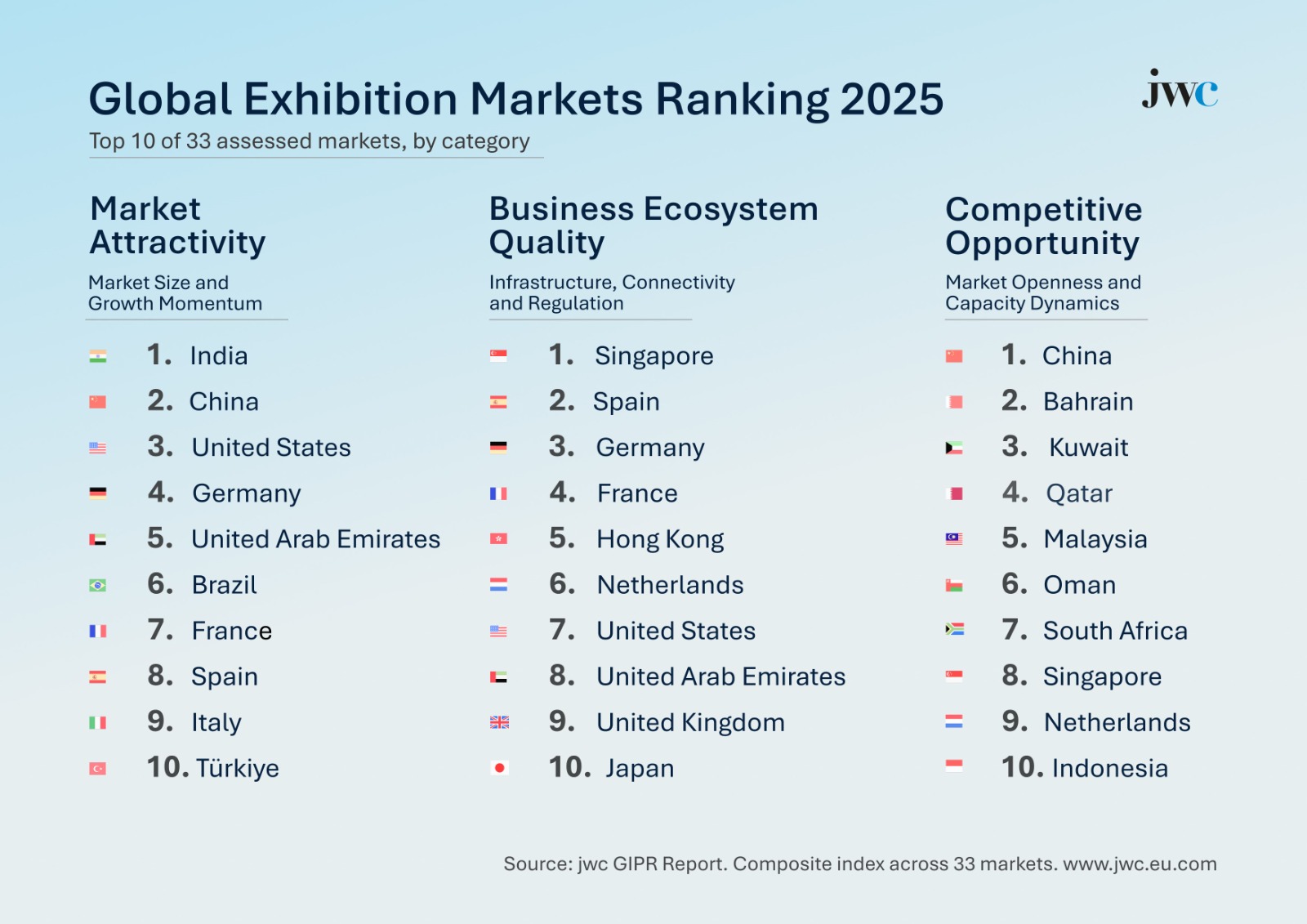
Beyond the overall rankings, the newly introduced “jwc Top-10 Exhibition Markets Tables” feature three scored-criteria segments that highlight clear market leaders based on specific strategic strengths. These rankings form a new component of jwc’s regular “GIPR” report.
In the market-driven segment, which prioritizes market size and growth outlook, India ranks first, reflecting strong demand fundamentals and expansion potential. China and the United States follow closely, underscoring the continuing importance of scale in volume-driven markets.
The competition-driven segment, evaluating openness, fragmentation, and competitive accessibility, is led by China, followed by Bahrain and Kuwait. This demonstrates how regulatory frameworks and competitive structures can create opportunities even within smaller markets.
In the ecosystem-driven segment, Singapore ranks first, supported by its highly institutionalised operating environment, strong international connectivity, and administrative efficiency. Spain and Germany follow, highlighting the importance of infrastructure, logistics performance, and overall business conditions in supporting exhibition growth.
Jochen Witt, Executive Chairman at jwc, noted that simplified headline rankings can often be misleading. He emphasized that markets can be attractive for very different reasons—whether due to scale, competitive openness, or ecosystem maturity—and that a multidimensional framework makes these trade-offs visible rather than masking them.
The Importance of a Multidimensional Approach
The analysis underscores that exhibition markets are not homogeneous. They operate at different stages of development, combining scale, growth, and ecosystem maturity in varying ways. While some markets are large but structurally constrained, others are smaller yet highly efficient. A growing number are rapidly expanding due to targeted investment and supportive policies.
The findings indicate that single-metric comparisons are increasingly insufficient. By separating market size, competitive dynamics, venue capacity, ecosystem readiness, and business conditions, the jwc framework enables a more nuanced comparison of markets with distinct development trajectories.
Lorenzo Garbujo, jwc project lead, stated that market attractiveness ultimately depends on strategic objectives. The framework is designed to assist organizers in prioritizing markets based on their specific business goals.
Overall, the results demonstrate that no single exhibition market is universally optimal. Instead, attractiveness is shaped by how scale, growth, competition, and ecosystem conditions interact—and how these factors align with strategic priorities.